
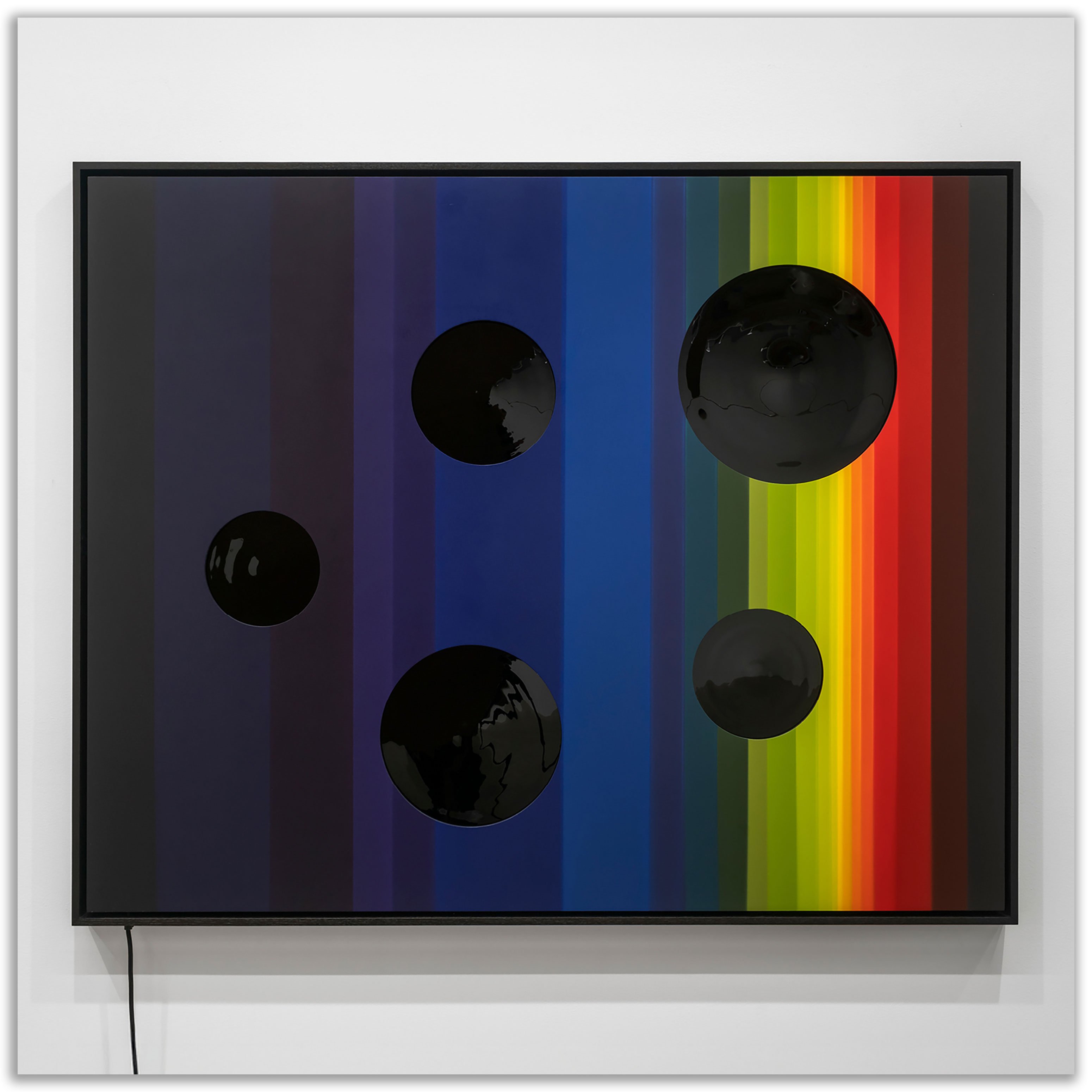
Forthcoming release 11/06
Three questions:
What happens when one form of energy is changed into another?
What shifts when you expand the limits of the color spectrum?
What activates when a spectator is able to hear a color or see a sound?
The answers all have to do with the interrelated triad of transduction, spectra, and synesthesia. These are basic science concepts, but they are also metaphors for the act of transformation. A way of representing fundamental change, of imagining the mutable nature of objective reality, and how that might represent our optimal collective futurity.
In From Red Black to Black, from Blue Black to Black, McElheny offers six extraordinary meditations on these questions. Four wall-hanging works incorporate embedded hand-blown vibrating glass discs that transduce and resonate sound signals. These “singing paintings” amplify musical works by David Grubbs that were especially commissioned for these pieces, as were all the sounds in the show. A combination floor-and wall-based sculptural installation stretches a red-sheathed cable around the interior of the space, transporting a heartbeat-like, non-repeating, non-metronomic signal from a Serge synthesizer (the “People’s Synthesizer,” designed in 1972) to a drum-like cylindrical shell embedded with colored glass discs – vintage optical filters in a dazzling array of hues – the top of which transduces the sound by way of a white glass “drum head.” A major floor sculpture at the center of the exhibition is based on the Leslie speaker system best known from soul jazz organ groups; across intervals of silence the melody from a Baroque chorale alternates with the musical trainwrecks of progressively slowed-down harmony parts. Along with the sculpture’s spinning, doppler-effect inducing horn element, like the paintings its surface is marked with painted color spectra.
The sequence and proportion of these colors reflect McElheny’s profound engagement with 19th century explorations of chromatic spectra, in particular the work of French chemist Michel Eugène Chevreul. The title of the show refers to McElheny’s radical idea that the color black exists as an expanded infinite place at the beginning and end of the color spectrum. Unlike Sir Isaac Newton, who insisted that black does not exist as a part of light or color, or Johann Wolfgang von Goethe, who theorized that color only comes out of shadow – or blackness – as the opposite of light, and that black is not a color in itself, McElheny’s vision puts black at the core of real color, as a full-fledged component of the visible electromagnetic spectrum.
In From Red Black to Black, from Blue Black to Black, McElheny effectively decouples the spectral from the prismatic, so the selection, order, and proportionality of its elements is not predetermined. Spectrum as domain of conceptual invention and intervention, upending its rootedness in physics or optics. An aprismatic artifact of rigorous imagination.McElheny was inspired and challenged by the alternative methods – freedoms – investigated by Milford Graves and Joe McPhee. These musicians have taken as building blocks mutable rhythms and microtonality rather than regular time and the diatonic scale. Grubbs’s sound source for the four paintings is a slide guitar, with which he patiently explores the timbral effects of microtonal variation. McElheny approaches the notion of color spectrum similarly, as a flexible system with constituent elements to be stretched or compressed, perhaps to a point of infinite possibility: a far more expansive notion than gradation guided by an axiomatic set of rules. Seeking a connection between the musical and visual expression of this alterity, the exhibition gradually metamorphosed from the narrower concept of transduction into something more inclusive, a capacious sense of chromesthesia in which sound evokes color and thereby stimulates new vibratory realms.
- John Corbett
David Grubbs: lap steel, electric guitar, Serge synthesizer
Recorded June–August, 2023 by Mitch Rackin at Deep Dive, Brooklyn. Mastered by Mitch Rackin. Published by Gastr Virgo Music (BMI). Thanks to Josiah McElheny, Keith Fullerton Whitman, John Corbett, Jim Dempsey, and Cathy Bowman.
Cover: From Red Black to Blue Black (Cassiopeia), 2023
Acrylic paint on panel, wood frame, hand blown glass gong, transducers, amplifier, audio player, wiring, electrical cable and plug, sound composition by David Grubbs
46 5/8 x 58 1/2 x 1 3/4 inches, cabling dimensions variable
CvsDCD130