
Ivy Wilson on the Duke Ellington Passport
Saturday, February 21 | 2PM
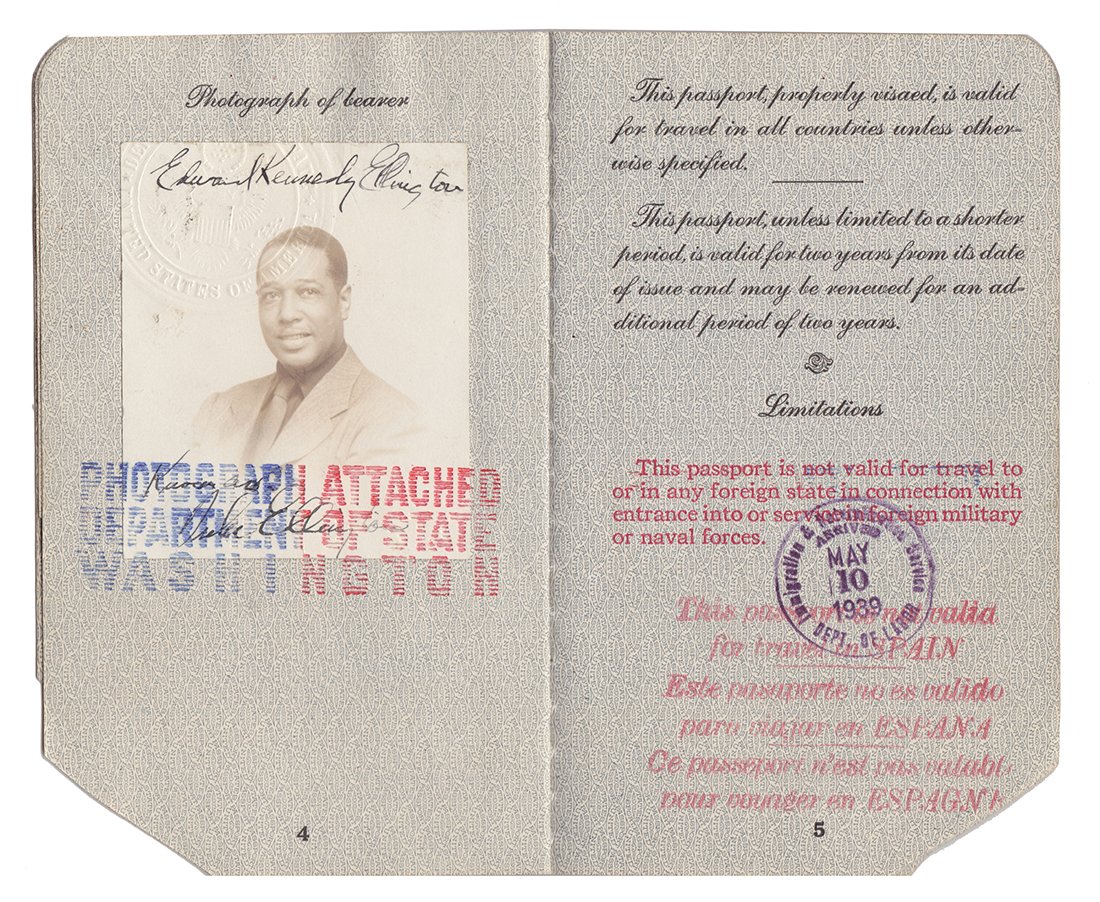
Corbett vs. Dempsey invites you to a conversation with Ivy Wilson, Associate Professor of English at Northwestern University. Wilson and John Corbett will discuss the current "secret" exhibition at CvsD of Duke Ellington's 1939 U.S. passport, touching on the significance of personal documentation in periods of international crisis (with reflections on our own time and the trope of having one's "papers" in order) and the status of ephemeral material culture in the landscape of African American history and the complex processes of archive-based historiography.
One of the towering composers, pianists, and bandleaders in 20th century music, Edward Kennedy "Duke" Ellington (1988-1974) wrote an essential segment of the great American songbook, his unique approach to arrangement and orchestration influencing generations of followers. Ellington was a genuine American icon, and few periods in his career were as pivotal as 1939, when he emerged from a slump and would soon assemble the version of his band (with saxophonist Ben Webster and bassist Jimmy Blanton) that would reassert his place in the pantheon. In May of that fateful year, when World War II was imminent and African Americans were banned from performing in Germany, Ellington acquired a passport in order to mount an ambitious European tour. Granted passage through Germany en route from France to Scandinavia, the train carrying Ellington's orchestra was detained in Hamburg. This episode, which can only have been a terrifying experience, is chronicled in the passport's official Nazi stamps, which eventually granted the band safe passage into the port and onboard the ship. Wilson will share thoughts on this remarkable archival object and its multiple layers of meaning.
IVY WILSON (Ph.D. Yale University) teaches courses on the comparative literatures of the Black diaspora and U.S. literary studies with a particular emphasis on African American culture. His book, Specters of Democracy: Blackness and the Aesthetics of Nationalism (Oxford, 2011), interrogates how the figurations and tropes of Blackness were used to produce the social equations that regulated the cultural meanings of U.S. citizenship and traces how African American intellectuals manipulated the field of aesthetics as a means to enter into political discourse about the forms of subjectivity and national belonging. Along with articles in ESQ, Arizona Quarterly, and PMLA, Wilson's other work in U.S. literary studies includes edited volumes on James Monroe Whitfield, Albery Allson Whitman, Walt Whitman, and on the emergent scholarship in American literary and cultural studies of the “long” nineteenth century. His current research interests focus on the solubility of nationalism in relationship to theories of the diaspora, global economies of culture, and circuits of the super-national and sub-national.